
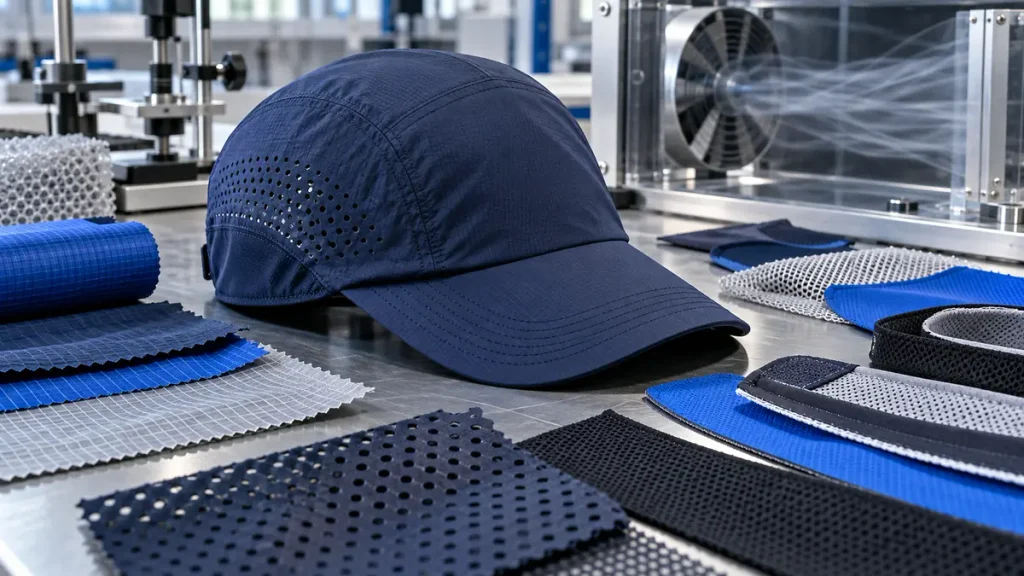
Sports headwear has to manage heat, movement and repeated wear while remaining lightweight and comfortable. The word “performance” covers many different fabrics and finishes, so buyers should select features according to the activity instead of requesting every available option.

### Moisture Management

Moisture-managing fabrics are designed to move perspiration away from the skin and spread it across a larger surface where it can dry more easily. The sweatband is equally important because it sits directly against the forehead.

For running, training and warm-weather use, test the body fabric and sweatband together. A quick-drying crown will not solve discomfort if the sweatband stays saturated.

### Ventilation

Airflow can be improved through mesh panels, perforated fabric, laser-cut holes or strategically placed eyelets. The best solution depends on the cap structure and desired appearance.

Large ventilation areas reduce heat buildup but may also change crown stability and logo placement. A balanced design keeps branding on a stable panel and places ventilation where it can work without weakening the shape.

### Lightweight Construction

Fabric weight, brim material, seam construction and closure hardware all contribute to the total feel of a cap. Lightweight does not mean fragile; ripstop weaves and reinforced stress points can provide strength without excessive bulk.

For endurance activities, small differences in weight and seam placement can affect comfort over time. The inside of the cap should be reviewed as carefully as the outside.

### Stretch and Fit

Mechanical stretch or elastic-blend fabrics can improve freedom of movement and help the crown adapt to different head shapes. However, stretch must be coordinated with the pattern, sweatband and closure.

Too much tension may distort embroidery or create pressure around the head. Fit trials on more than one wearer are useful before final approval.

### Sun and Weather Considerations

Outdoor caps may use water-repellent finishes, longer brims or neck protection depending on the application. If a specific protective claim is required, the relevant fabric and finished product should be evaluated under the appropriate test method.

Avoid assuming that color, thickness or a marketing name alone proves a performance level.

### Decoration for Technical Fabrics

Heat-transfer graphics, reflective prints and lightweight patches are common choices for sports caps. Dense embroidery can add weight or pucker thin fabric, although small embroidery may still work when the backing and stitch count are properly controlled.

### Develop Around the Real Activity

A running cap, golf cap and outdoor work cap have different priorities. Tell the manufacturer the climate, wearing duration, washing expectations, branding needs and target cost. Then test the proposed combination as a finished sample.

Performance comes from the complete construction, not one fabric label. When crown material, sweatband, ventilation, fit and decoration work together, the cap can remain comfortable while delivering the required brand appearance.