
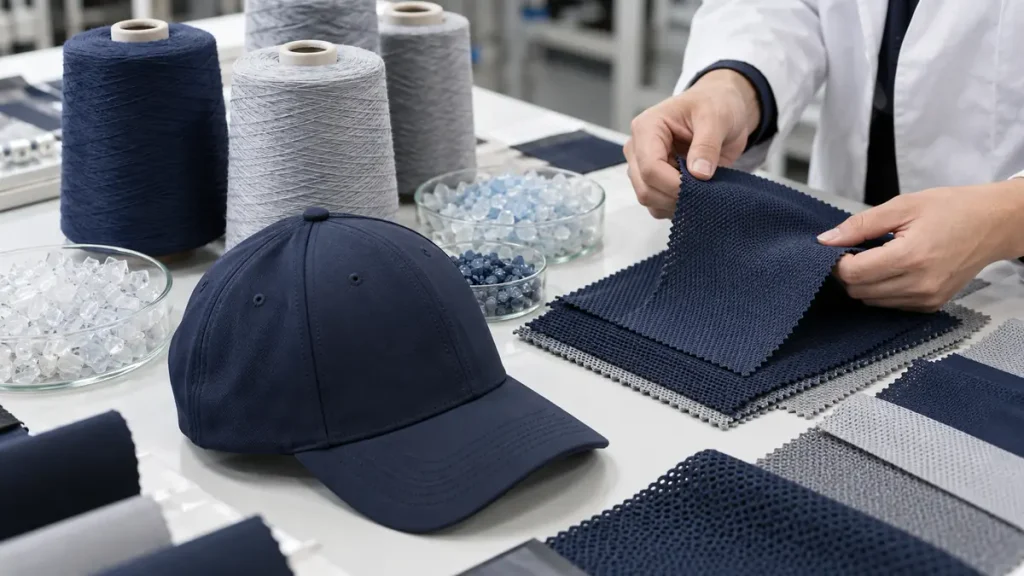
Recycled polyester is increasingly considered for custom caps, especially in sports, outdoor and promotional programs. It can provide many of the practical qualities associated with conventional polyester, but buyers should evaluate the complete fabric specification rather than treating “recycled” as a guarantee of performance.

### What Recycled Polyester Means

Recycled polyester is made using recovered polyester feedstock, which may come from post-consumer or industrial sources. The material is processed into chips, yarn and fabric before being cut and sewn into a cap.

The recycled content percentage can vary between materials. If a project has a specific sourcing policy, the required percentage and documentation should be discussed before sampling.

### Why It Works for Headwear

Polyester fabrics can be lightweight, durable and quick-drying, making them useful for running caps, outdoor hats and uniforms. They can also be engineered as woven, knitted, mesh or ripstop constructions.

The final result depends on yarn, fabric structure, finishing and weight. Two fabrics described as recycled polyester may feel and perform very differently, so an actual swatch is more useful than a generic material name.

### Check Hand Feel, Color and Structure

A cap needs enough body to hold the intended shape. A thin fabric may work well for an unstructured sports cap but not for a high-profile structured crown without additional support.

Color should be approved under consistent lighting. Dark navy, black and bright brand colors can vary between dye lots or material suppliers. When color accuracy is critical, use a recognized color reference and confirm the final fabric sample.

### Match Decoration to the Fabric

Dense embroidery can pull or wrinkle lightweight polyester. Low-density stitching, a woven patch or heat-transfer graphic may create a cleaner result. Heat-sensitive coatings also require testing before transfer temperature and pressure are confirmed.

For mesh or perforated panels, keep detailed branding on a stable front panel whenever possible.

### Ask for Relevant Documentation

If material claims will appear on packaging, product pages or buyer documentation, confirm what evidence the supplier can provide. Requirements differ between programs and markets, so the expected document type should be agreed before the material is ordered.

Documentation should relate to the selected material and supply chain, not simply to a similar fabric.

### Approve a Finished Sample

Review the recycled fabric as part of a complete cap. Check shape, comfort, recovery, stitching, logo appearance and any required care performance. A material that looks suitable as a flat swatch may behave differently after cutting, sewing and shaping.

Recycled polyester can be a practical option when it meets the product's actual needs. Clear specifications, traceable material selection and physical testing help turn a general sustainability goal into a cap that also performs well and can be produced consistently.